








Charles Dickens’s novel Oliver Twist portrays a gruesome murder of a character named Nancy. Beaten to death by her abusive lover, Bill Sikes, Nancy’s violent death scandalized Victorian readers, which is not so surprising given this passage:
“The housebreaker [Bill Sikes] freed one arm, and grasped his pistol. The certainty of immediate detection if he fired, flashed across his mind even in the midst of his fury; and he beat it twice with all the force he could summon, upon the upturned face that almost touched his own.
She [Nancy] staggered and fell: nearly blinded with the blood that rained down from a deep gash in her forehead; but raising herself, with difficulty, on her knees, drew from her bosom a white handkerchief—Rose Maylie’s own—and holding it up, in her folded hands, as high towards Heaven as her feeble strength would allow, breathed one prayer for mercy to her Maker.
It was a ghastly figure to look upon. The murderer staggering backward to the wall, and shutting out the sight with his hand, seized a heavy club and struck her down.”
Nancy’s demise was not a total fabrication from Dickens’s mind. While writing Oliver Twist, the murder of Eliza Grimwood shocked London. Her death sent ripples through the press as the police struggled to find her murderer. Dickens devoured these articles, piecing the details together to create his character Nancy’s death.
On May 26, 1838, Eliza Grimwood crossed over the River Thames from Lambeth. This was part of her nightly routine as a high-end sex worker frequenting the West End theatres in search of customers. On this night, she chose the Strand Theatre, which had a reputation as an assignation place for beautiful courtesans and monied patrons.
At the Strand, Eliza met a young man who spoke English with a French accent. Together, the two called a cab and crossed the Waterloo Bridge. According to Spicknell, their cab driver, the man “had very much the appearance of a gentleman.”
Charles Dickens based his character Nancy’s death on Eliza Grimwood’s murder in his classic novel, Oliver Twist. (Credit: Wikimedia Commons, Public Domain)
They arrived at Eliza’s home, No. 12 Wellington Terrace, shortly after midnight. Eliza’s servant, Mary Fisher, let them into the house. Strangely, the man angled his face away from Mary and hurried into the parlor. Other than thinking his behavior was odd, Mary Fisher saw no reason for concern. On Eliza’s orders, Mary Fisher returned to bed.
Eliza did not live with only Mary at No. 12 Wellington Terrace. Mary Glover, another sex worker, William Best, a commercial traveler, and William Hubbard, Eliza’s domestic partner and first cousin, shared the home. William Hubbard was already married, but he had left his wife twelve years prior. For nearly a decade, he had been romantically attached to Eliza. He slept in a separate apartment within the household while she entertained her customers, but he was known to be jealous of certain customers.
After Mary Fisher returned to bed, Eliza retired to a ground floor bedchamber with her customer. Presumably to entertain him, as she had numerous other gentlemen, in those quarters. Nothing was heard through the night. No noise. No sound. Nothing suspicious occurred. It seemed like any other night in Eliza’s routine.
However, William Hubbard discovered Eliza’s mutilated body around six o’clock in the morning. Eliza lay on the floor, her throat slashed, her abdomen torn into, and blood splattered everywhere. There was so much blood, it indicated Eliza had fought off her attacker.
Horrified, William sounded the alarm, shouting “Murder!” Mary Fisher awoke to his cries for help, and very soon, the whole house was in an uproar. The English-speaking Frenchman she had returned home with was missing, and no one had any clue as to where he had gone or when he had left.
A policeman named Inspector Field arrived at the house. He searched the premises, finding a purse full of gold guineas missing. However, Eliza’s lavish jewelry remained in the room and eight shillings were found on the bedside, left possibly by her last customer.
An illustration of Eliza Grimwood. (Credit: Yesterday’s Papers)
Inspector Field concluded there were two possible suspects. Either Eliza’s last customer, the suspicious Frenchman, or William Hubbard murdered her. While raising the alarm for the murder, William claimed to have run into a man outside who seemed too quick and eager to lend his assistance. This would be convenient, though, if William was the murderer.
In addition to this, the first policeman ushered into the crime scene observed William remove those eight or so shillings from the bedside table. If those had been left by her last customer, it seemed unlikely he was the murderer. If anyone, it was William.
William was also violent and jealous. Upon his marriage, his wife had a small fortune of 400l. and jewelry worth roughly 50l. William squandered this money and physically assaulted her often. One day, he beat her so dreadfully and turned her out of their house, leaving her to fend for herself.
With Eliza, William was jealous of her regular, wealthy patrons. One in particular was William Osborne, a sword-cutler, who intended to take Eliza to the Epsom races. William vehemently forbade it, but Eliza planned to go with Osborne anyway. Mainly living off of Eliza’s money, even if he earned a small income as a sex worker’s “bodyguard,” William Hubbard had little say in how their money was made.
Sometime after the murder, Inspector Field received a letter from a John Walter Cavendish. The letter read:
“Goswell-street, June 8, 1838
Sir, – Though with the greatest reluctance, a sense of duty I owe to every fellow creature, and that justice may be obtained, compels me to break my silence touching the melancholy death of Eliza Grimwood. Ever since the horrid deed has been perpetrated I have had the public prints, and have attended the inquiry whenever I could obtain admittance, though in disguise, but have as yet remained silent. I am the person who accompanied Eliza Grimwood home on the night in question from the Strand Theatre.”
This Cavendish continued on, claiming that William Hubbard had bullied him and tossed him from their house the night of the murder. William was swiftly arrested.
But physical evidence exonerated William. There was no blood on William’s shirt when the police arrived at the house on May 26th. None of his other shirts were found to have blood. Only his pants had blood stains on them, but he claimed that was from walking in on the blood-soaked crime scene. The coroner believed the murderer would have been drenched in blood, and William hadn’t been.
The coroner also believed Eliza had been attacked with a Spanish switchblade, its blade being ½ inch thick. No such weapon was recovered in William’s possession or from the house.
For Inspector Field, this left only one other possible suspect. The foreign Frenchman who had returned to the house that night with Eliza. But no one could ever identify him. This left Inspector Field wondering if a ghost had murdered her—or if her attacker had killed before.
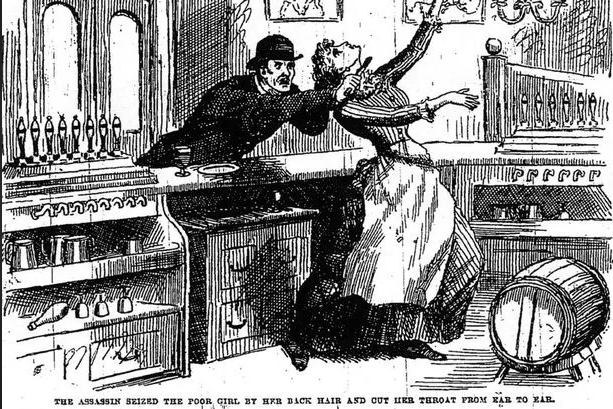
Several men confessed to her murder in the years after. In 1845, a soldier named George Hill confessed to get out of his military duties. In 1840, there was a more convincing possibility. Swiss valet François Benjamin Courvoisier awaited execution while languishing away in Newgate for the murder of his employer, Lord William Russell. He wanted to confess to the murder of Eliza Grimwood—and a barmaid named Eliza Davies, who had been murdered in a similar fashion on May 10, 1837.
An illustration of the murder of Eliza Davies from the Illustrated Police News, December 22, 1888. (Credit: Wales Online)
Interestingly, Eliza Davies’s first death anniversary fell little more than a fortnight before Eliza Grimwood’s murder. Inspector Field believed Eliza Grimwood’s attacker had murdered before. Additionally, those who gave testimony on the appearance of the “swarthy” and “foreign” man who had accompanied Eliza Grimwood home that night was also described as a gentleman or a gentleman’s servant. Courvoisier was both foreign and a gentleman’s servant.
Lastly, Courvoisier had been born in Mont-la-Ville, Switzerland, a municipality very close to the French border. There is such a thing as a Swiss-French accent, which might have been mistaken for a French accent by common Londoners unfamiliar with the differences. Eliza’s foreign customer might not have been French at all but Swiss.
Courvoisier’s uncle convinced him to lock his loose lips. He was hanged on July 6, 1840, possibly as an unconfirmed serial killer. Whatever knowledge he possessed for additional murders was lost with his last breath.
In all likelihood, Eliza Grimwood’s slaying will remain unsolved. Scarce information on her life exists, leaving Eliza Grimwood as a person, as a victim, largely unknown. More tragically, her murder—rather than her life—is immortalized in Charles Dickens’s Oliver Twist through Nancy’s similar death.
If you enjoyed this blog post, please consider supporting me over at Buy Me a Coffee! This Enduring Writer could really use the caffeine to keep creating.
Credit by : Reddit.com